Drone Delivery Becomes a Reality in Remote Pacific Islands

Drone Delivery Becomes a Reality in Remote Pacific Islands

  • June 2, 2018
Table of Contents

Drone Delivery Becomes a Reality in Remote Pacific Islands

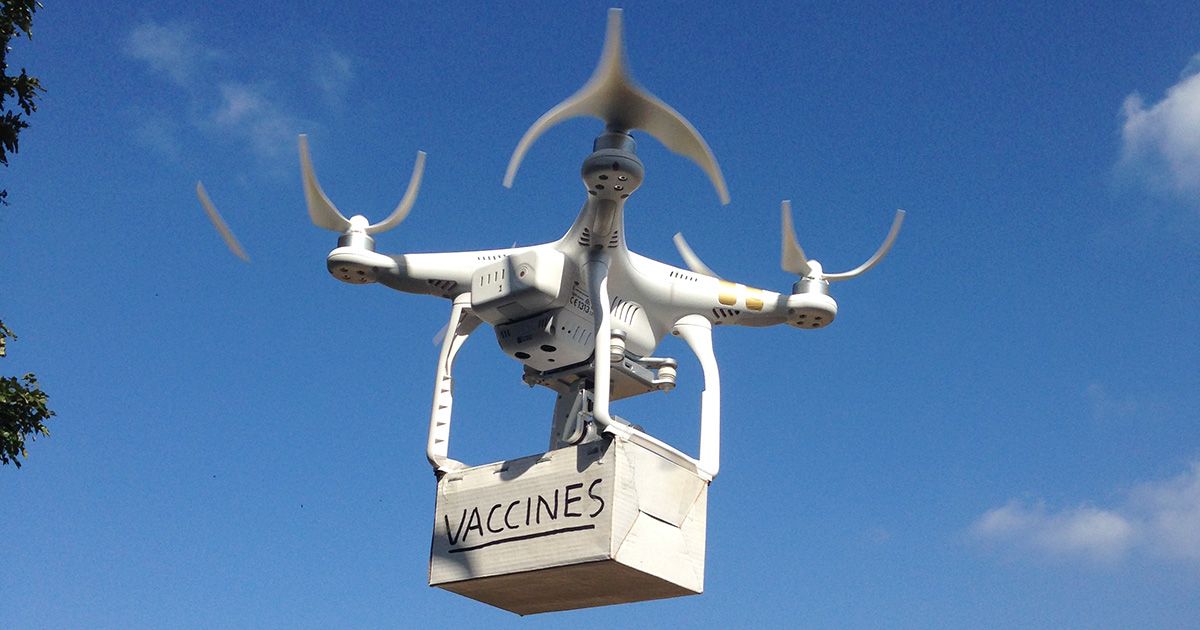
Currently, health workers in Vanuatu often hike over mountains to deliver vaccines–but drones can fly over them. This September, delivery drones will begin to fly the friendly skies of Vanuatu. And this isn’t a one-shot demonstration, like many of the stunts we’ve seen from the likes of Amazon and Google.

This is an attempt to make drones part of the medical infrastructure. The South Pacific island nation of Vanuatu, a string of 83 volcanic islands spread over 1600 kilometers (995 miles), has just issued a “request for tender” to drone companies around the world. The companies are invited to submit bids for bringing vaccines to scattered hospitals and health clinics on three islands.

With a government contract available for each of the islands, up to three companies will then begin a two-month trial in September. Companies have a chance to prove both their technology and, just as importantly, their business model. For all the optimism that delivery drones will make economic sense in this context—where lightweight and urgently needed packages must be transported acrosswild and mountainous landscapes with few roads—the premise has yet to be proven.

The South Pacific nation of Vanuatu is composed of 83 volcanic islands spread over 1600 kilometers. The conditions in Vanuatu make vaccine distribution a tough challenge. Today, shipments are flown from the three major islands (which have cities and airports and such) to small rural islands in 9-seater planes.

When a plane rolls to a stop on the grass airstrip, it’s met by someone from the local health clinic—but that’s assuming that one of the few trucks on the island is available and in working order.

Source: ieee.org

Share :
comments powered by Disqus

Related Posts

Mice with 3D-Printed Ovaries Successfully Give Birth

Mice with 3D-Printed Ovaries Successfully Give Birth

AsKatherine Kornei at Science reports,the researchers used a 3D printer to build the scaffolding of the organs, weaving layers of gelatin to createtiny (15 x 15 millimeter) ovaries on glass slides. They then tested the scaffolds by embedding a follicle—the tiny sacs composed of hormone-secreting cells that containthe maturing eggs. This test suggested that the tightest weave supported the highest survival rates, reports Kornei.

Read More
Leading UK scientist reveals likely cause of childhood leukaemia

Leading UK scientist reveals likely cause of childhood leukaemia

Professor Mel Greaves from The Institute of Cancer Research, London, assessed the most comprehensive body of evidence ever collected on acute lymphoblastic leukaemia (ALL) – the most common type of childhood cancer. His research concludes that the disease is caused through a two-step process of genetic mutation and exposure to infection that means it may be preventable with treatments to stimulate or ‘prime’ the immune system in infancy. The first step involves a genetic mutation that occurs before birth in the foetus and predisposes children to leukaemia – but only 1 per cent of children born with this genetic change go on to develop the disease.

Read More
How an AI Startup Could Defeat Now Unbeatable Bugs

How an AI Startup Could Defeat Now Unbeatable Bugs

The need for new medications is higher than ever, but so is the cost and time to bring them to market. Developing a new drug can cost billions and take as long as 14 years, according to the U.S. Food and Drug Administration. Yet with all that effort, only 8 percent of drugs make it to market, the FDA said.

Read More