
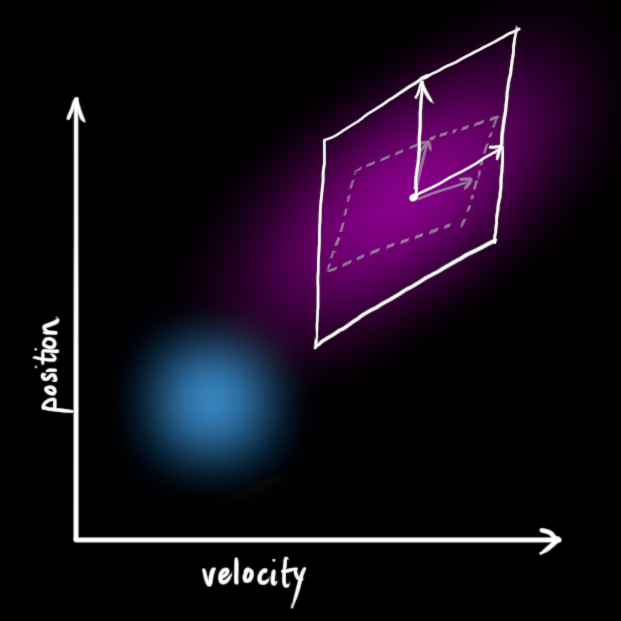
How a Kalman filter works, in pictures
Surprisingly few software engineers and scientists seem to know about it, and that makes me sad because it is such a general and powerful tool for combining information in the presence of uncertainty. At times its ability to extract accurate information seems almost magical— and if it sounds like I’m talking this up too much, then take a look at this previously posted video where I demonstrate a Kalman filter figuring out the orientation of a free-floating body by looking at its velocity. Totally neat!
Read More

Mathematicians Disprove Conjecture Made to Save Black Holes
Nearly 40 years after it was proposed, mathematicians have settled one of the most profound questions in the study of general relativity. In a paper posted online last fall, mathematicians Mihalis Dafermos and Jonathan Luk have proven that the strong cosmic censorship conjecture, which concerns the strange inner workings of black holes, is false. The strong cosmic censorship conjecture was proposed in 1979 by the influential physicist Roger Penrose.
Read MoreA Chemist Shines Light on a Surprising Prime Number Pattern
About a year ago, the theoretical chemist Salvatore Torquato met with the number theorist Matthew de Courcy-Ireland to explain that he had done something highly unorthodox with prime numbers, those positive integers that are divisible only by 1 and themselves. Torquato told de Courcy-Ireland, a final-year graduate student at Princeton who had been recommended by another mathematician, that a year before, on a hunch, he had performed diffraction on sequences of prime numbers. Hoping to highlight the elusive order in the distribution of the primes, he and his student Ge Zhang had modeled them as a one-dimensional sequence of particles — essentially, little spheres that can scatter light.
Read More
The best representations of mathematics may not exist yet
Humility. It’s all I can feel after watching 3Blue1Brown’s latest maths video, in which Grant Sanderson and his team provide the most novel of approaches to solving 2D equations, using colour. It is the second time 3Blue1Brown has blown my mind to pieces in just a few weeks, following their earlier video that solved the Basel problem with light.
Read More
We Need Bug Bounties for Bad Algorithms
Algorithmic auditors are a growing discipline of researchers specializing in computer science and human-computer interaction. They employ a variety of methods to tinker with and uncover how algorithms work, and their research has already sparked public discussions and regulatory investigations into the most dominant and powerful algorithms of the Information Age. From Uber and Booking.com to Google and Facebook, to name a few, these friendly auditors already uncovered bias and deception in the algorithms that control our lives.
Read More
The Gambler Who Cracked the Horse-Racing Code
On the evening of Nov. 6, 2001, all of Hong Kong was talking about the biggest jackpot the city had ever seen: at least HK$100 million (then about $13 million) for the winner of a single bet called the Triple Trio. The wager is a little like a trifecta of trifectas; it requires players to predict the top three horses, in any order, in three different heats. More than 10 million combinations are possible.
Read More
Lost in Math: Beauty != truth
In Lost in Math, Hossenfelder delves briefly into the history of particle physics in order to explain the success of the Standard Model of particles and forces. She touches on why we’ve not had any unexplainable data from experimental particle physics for the last 50 years. She then takes us on a tour of the data that make us think we should be looking for physics that is not explained by the Standard Model—dark matter, dark energy, and cosmic inflation.
Read More
How Poetry and Math Intersect
April is both National Poetry Month and Mathematics and Statistics Awareness Month, so a few years ago science writer Stephen Ornes dubbed it Math Poetry Month. If the words “math” and “poetry” don’t intuitively make sense to you as a pair, poet and mathematician JoAnne Growney’s blog Intersections—Poetry with Mathematics is a perfect place to start expanding your math-poetic horizons. The blog includes a broad range of poems with mathematical themes or built using mathematical rules.
Read More
Algorithms tutorial for beginners
As a developer, you have the power to change the world! You can write programs that enable new technologies. You might work in software to find an earlier diagnosis of diseases.
Read More
Decades-Old Graph Problem Yields to Amateur Mathematician
It is unusual, but not unheard of, for an amateur mathematician to make significant progress on a long-standing open problem. In the 1970s, Marjorie Rice, a homemaker with no mathematical background, ran across a Scientific American column about pentagons that tile the plane. She eventually added four new pentagons to the list.
Read More
Probability Theory for Scientists and Engineers
In this case study I attempt to untangle this pedagogical knot to illuminate the basic concepts and manipulations of probability theory and how they can be implemented in practice. Our ultimate goal is to demystify what we can calculate in probability theory and how we can perform those calculations in practice. We begin with an introduction to abstract set theory, continue to probability theory, and then move onto practical implementations without any interpretational distraction.
Read More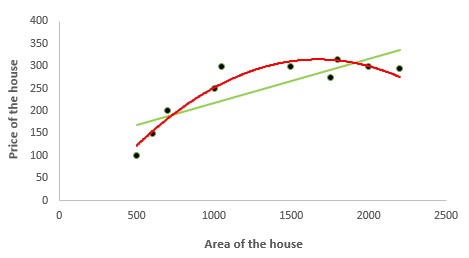
15 Types of Regression you should know
Regression techniques are one of the most popular statistical techniques used for predictive modeling and data mining tasks. On average, analytics professionals know only 2-3 types of regression which are commonly used in real world. They are linear and logistic regression.
Read More