

The Race to Develop the World’s Best Quantum Tech
A few days beforeChristmas, U.S. President Donald Trump signed a bill into law that devotesmore than US $1.2billion to a national effortdedicated toquantum information science over the next 10 years. The National Quantum Initiative Act represents a bipartisan U.S. government push to keep up withChina and other countries in developing technologies such asquantum computing, quantum cryptography, and quantum communication—all of which have some potential to upset the balance of economic and military powerin the world. Quantum computing has drawnspecial attention for its potential to someday crack the modern computer algorithms that protect government and corporate secrets.
Read More

Intel’s New Path to Quantum Computing
Intel’s director of quantum hardware, Jim Clarke, explains the company’s two quantum computing technologies The limits of Tangle Lake’s technology Silicon spin qubits and how far away they are The importance of cryogenic control electronics Top quantum computing applications What problems keeps him up at night AI vs. Quantum Computing: which will be more important? IEEE Spectrum: What’s special about Tangle Lake?
Read More


A videogame that powers quantum entanglement experiments
The random number generator Abellan wanted to use? Randos online. His group would design a game that used the 1 and 0 keys on a phone or computer keyboard as controller buttons.
Read More

Breakthrough pushes Quantum Key Distribution beyond 500km
Cambridge physicists have come up with a new way to build a secure Quantum Key Distribution (QKD) network that could extend the technology’s range beyond 500km for the first time.
Read More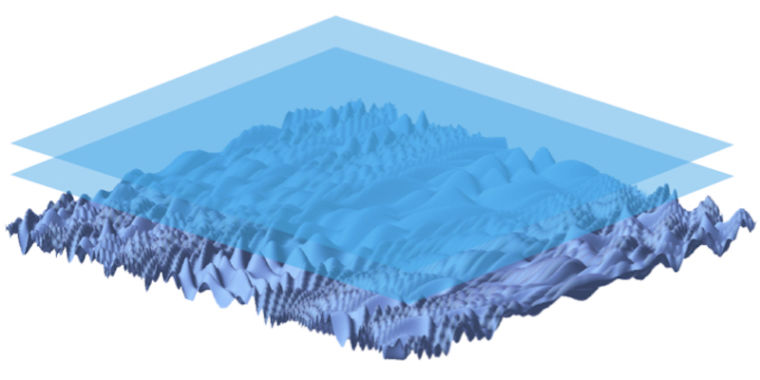
Random quantum circuit easiest way to beat classical computer
The key question: what computation should be performed? A team of researchers is suggesting that computing the state of a random quantum circuit that exhibits chaotic behavior would be perfect for the task. Let’s delve into why that might be.
Read More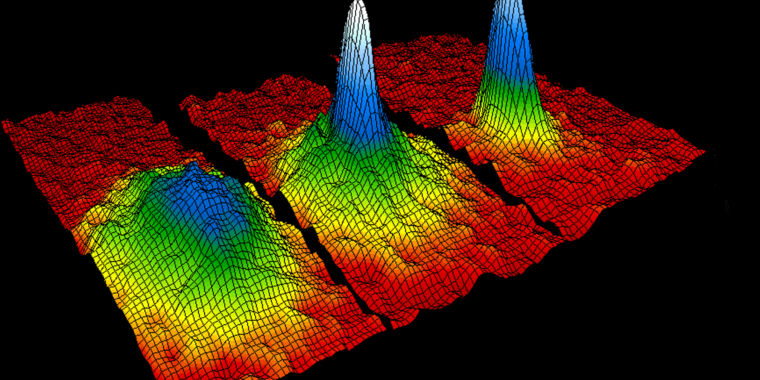
Clouds of atoms, vibrating mirrors show their quantum side
To say the quantum world is unintuitive is a staggering understatement. Particles end up in more than one place at a time, and the instances interact with each other. Decisions made after a photon has traversed an obstacle course determine the path it took through it.
Read More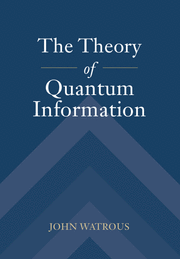
The Theory of Quantum Information
To be published by Cambridge University Press in April 2018. Upon publication this book will be available for purchase through Cambridge University Press and other standard distribution channels. Please see the publisher’s web page to pre-order the book or to obtain further details on its publication date.
Read More

20 Entangled Qubits Bring the Quantum Computer Closer
In 1981, Richard Feynman suggested that a quantum computer might be able to simulate the evolution of quantum systems much better than classical computers. Except for several proof-of-principle experiments, no working quantum computer has yet been built.
Read More
Quantum mechanics used for better random numbers
Researchers have come up with a way to generate truly random numbers using quantum mechanics. The method uses photons to generate a string of random ones and zeros, and leans on the laws of physics to prove that these strings are truly random, rather than merely posing as random.
Read More

Is it Time for Quantum Computing Startups? Maybe
That was the message of the Q Summit, a one-day meeting of quantum computing researchers, investors, and entrepreneurs hosted by IBM in Menlo Park, Calif., last week.
Read More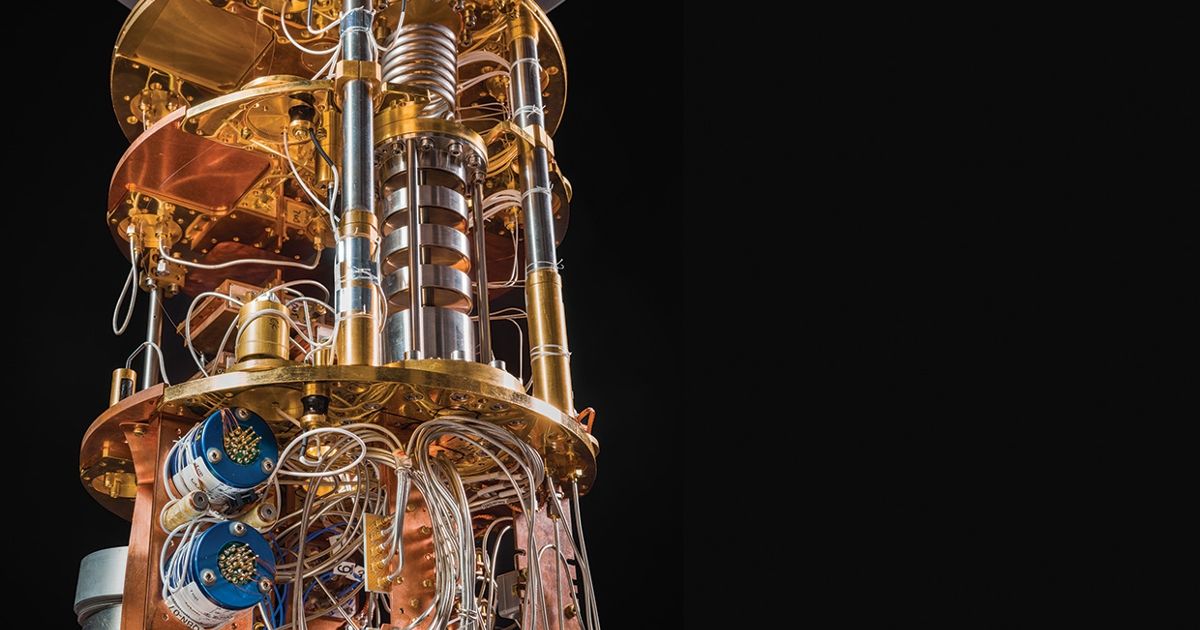
Quantum Computers Strive to Break Out of the Lab
Schrödinger’s famous thought experiment has come to life in a new form because quantum researchers are at the cusp of a long-sought accomplishment: creating a quantum computer that can do something notraditional computer can match. They’ve spent years battling naysayers who insisted that a quantum computer was an unachievable sci-fi fantasy, and nowthese researchers are finally beginning to indulge in some well-deserved self-congratulation.
Read More
Physicists discover new quantum electronic material
MIT, Harvard, and LBNL physicists have discovered a new quantum electronic material, the “kagome metal,” whose atomic structure resembles a Japanese basketweaving pattern and exhibits exotic, quantum behavior.
Read More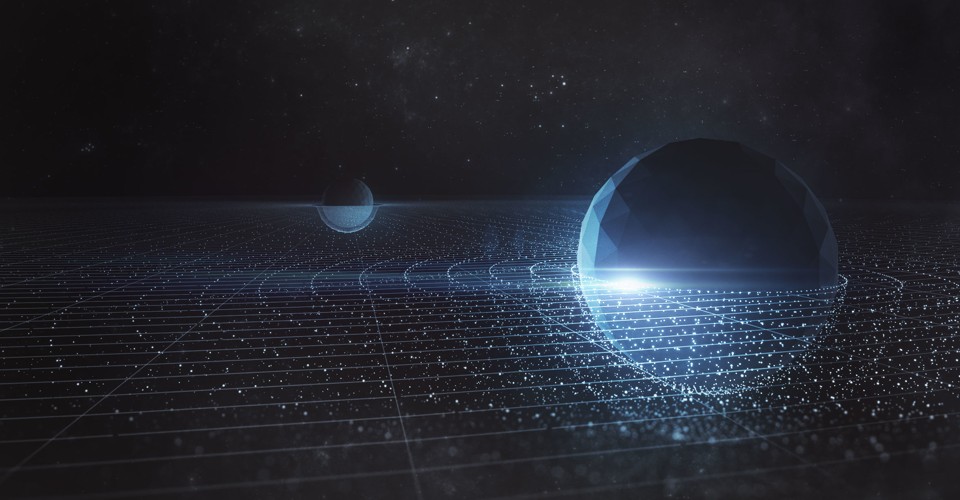
Will the Quantum Nature of Gravity Finally Be Measured?
In 1935, when both quantum mechanics and Albert Einstein’s general theory of relativity were young, a little-known Soviet physicist named Matvei Bronstein, just 28 himself, made the first detailed study of the problem of reconciling the two in a quantum theory of gravity. This “possible theory of the world as a whole,” as Bronstein called it, would supplant Einstein’s classical description of gravity, which casts it as curves in the space-time continuum, and rewrite it in the same quantum language as the rest of physics.
Read More
Can retrocausality solve the puzzle of action-at-a-distance?
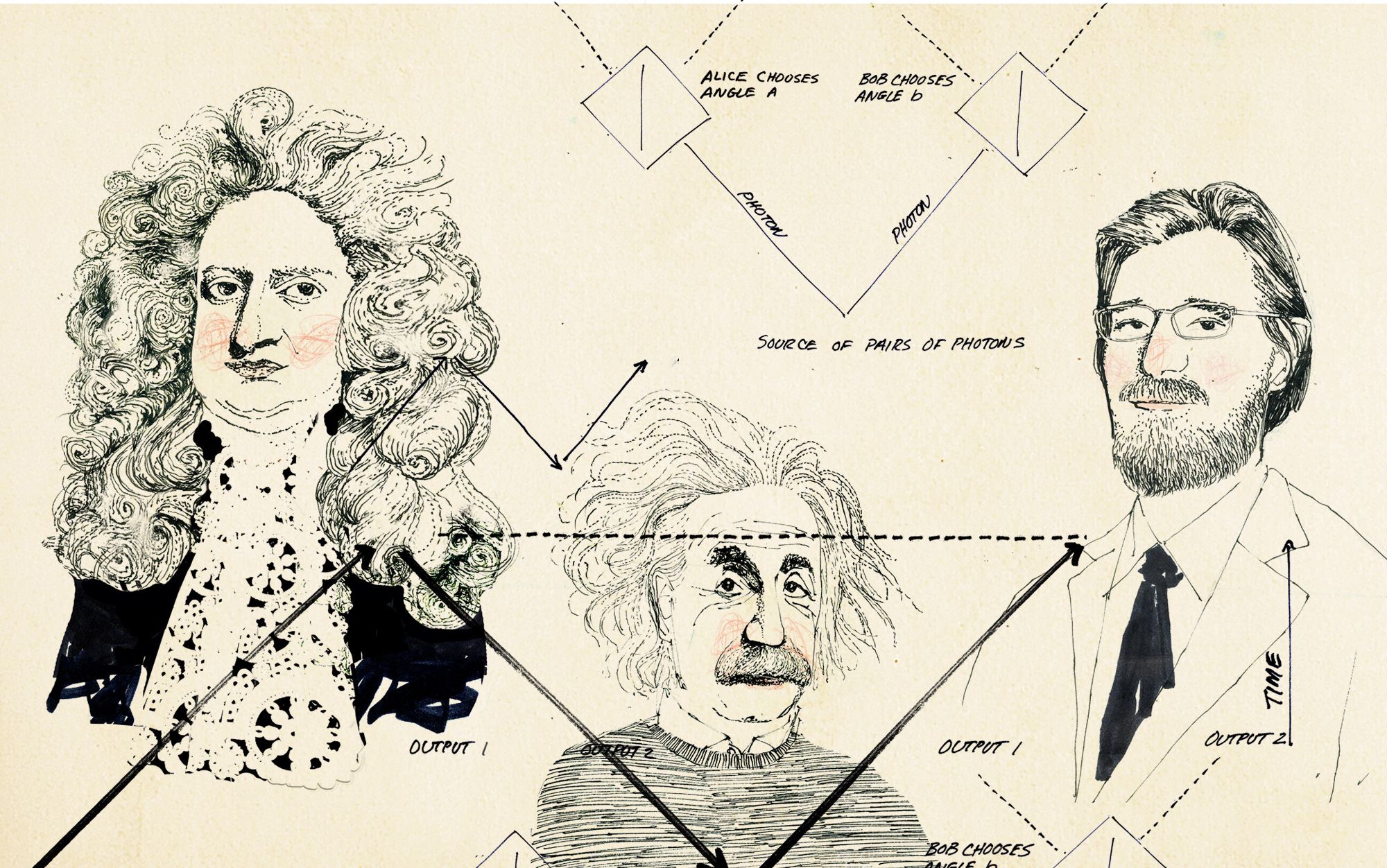
Einstein’s objections to quantum mechanics began very early. Schrödinger’s version of the theory introduced a new mathematical entity, the wave function, which seemed to allow the position of an unmeasured particle to be spread out across an arbitrarily large region of space. When the particle’s position was measured, the wave function was said to ‘collapse’, suddenly becoming localised where the particle was detected.
Read More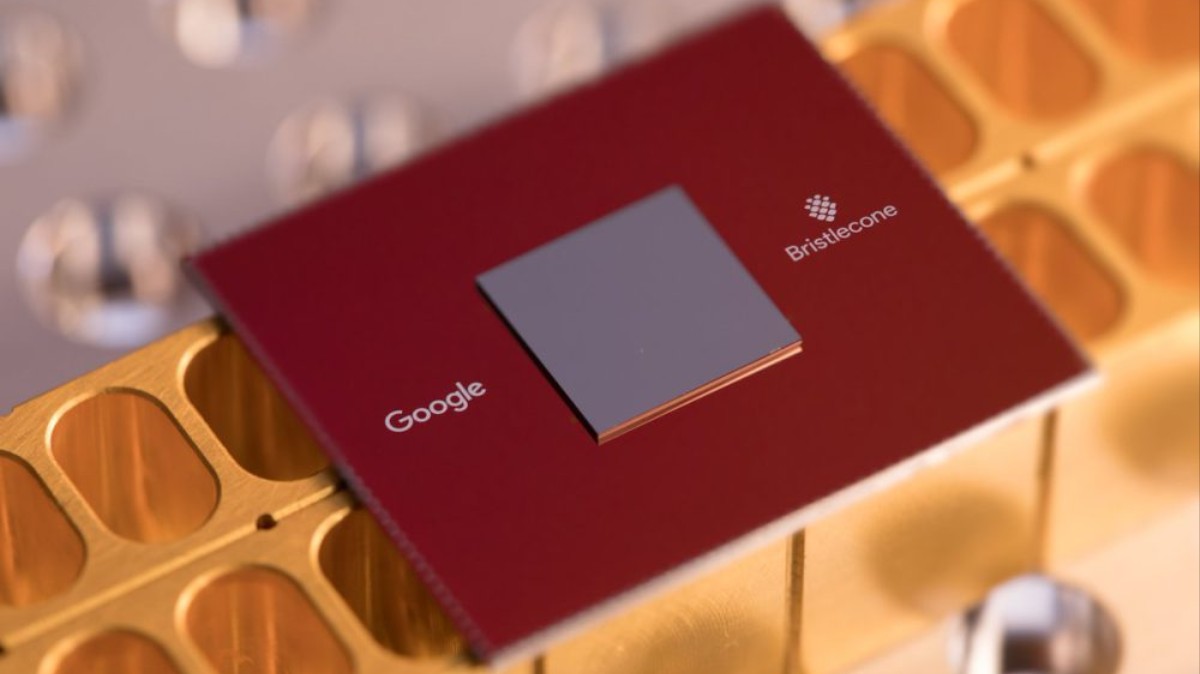

Google Unveils 72-Qubit Quantum Computer With Low Error Rates
If a quantum processor can be operated with low enough error, it would be able to outperform a classical supercomputer on a well-defined computer science problem, an achievement known as quantum supremacy. These random circuits must be large in both number of qubits as well as computational length (depth). Although no one has achieved this goal yet, we calculate quantum supremacy can be comfortably demonstrated with 49 qubits, a circuit depth exceeding 40, and a two-qubit error below 0.5%.
Read More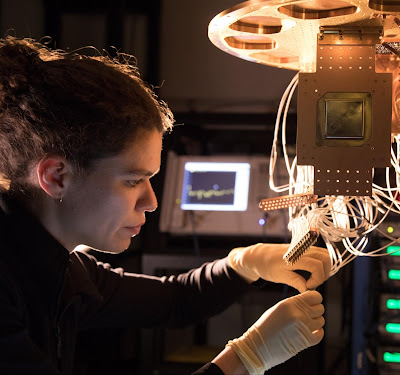
A Preview of Bristlecone, Google’s New Quantum Processor
The goal of the Google Quantum AI lab is to build a quantum computer that can be used to solve real-world problems. Our strategy is to explore near-term applications using systems that are forward compatible to a large-scale universal error-corrected quantum computer. In order for a quantum processor to be able to run algorithms beyond the scope of classical simulations, it requires not only a large number of qubits.
Read More

Demystifying Quantum Gates — One Qubit At A Time
If you want to get into quantum computing, there’s no way around it: you will have to master the cloudy concept of the quantum gate. Like everything in quantum computing, not to mention quantum mechanics, quantum gates are shrouded in an unfamiliar fog of jargon and matrix mathematics that reflects the quantum mystery. My goal in this post is to peel off a few layers of that mystery.
Read More