News
- Home /
- News
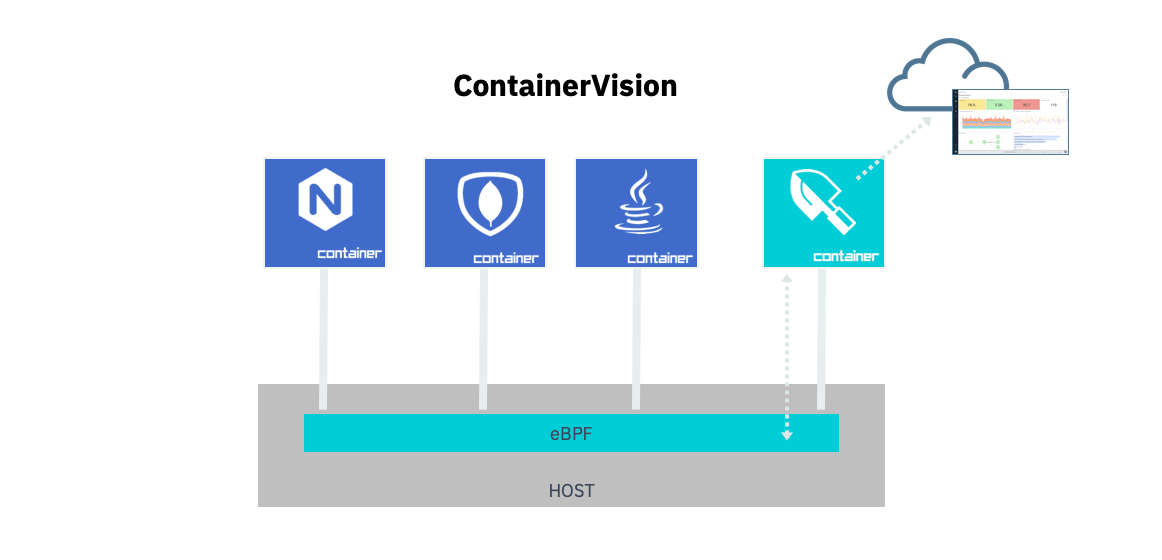
Introducing container observability with eBPF and Sysdig.
Today we’ve announced that we’ve officially added eBPF instrumentation to extend container observability with Sysdig monitoring, security and forensics solutions. eBPF – extended Berkeley Packet Filter – is a Linux-native in-kernel virtual machine that enables secure, low-overhead tracing for application performance and event observability and analysis. Don’t let the name fool you – eBPF delivers a lot more than network packet information (more on that below).
Read More

Grafana v6.0 Released
Grafana v6.0 brings many new and exciting features and enhancements and at the same time includes a new React platform and architecture for panels & plugins that will fundamentally change Grafana’s future as a platform. Grafana’s dashboard UI is all about building dashboards for visualization. Explore strips away all the dashboard and panel options so that you can focus on the query & metric exploration.
Read More
Podman and Buildah for Docker users
I was asked recently on Twitter to better explain Podman and Buildah for someone familiar with Docker. Though there are many blogs and tutorials out there, which I will list later, we in the community have not centralized an explanation of how Docker users move from Docker to Podman and Buildah. Also what role does Buildah play?
Read More
Infrastructure monitoring: Defense against surprise downtime
Infrastructure monitoring is an integral part of infrastructure management. It is an IT manager’s first line of defense against surprise downtime. Severe issues can inject considerable downtime to live infrastructure, sometimes causing heavy loss of money and material.
Read More

Cilium 1.4: Multi-Cluster Service Routing, DNS Authorization
We are excited to announce the Cilium 1.4 release. The release introduces several new features as well as optimization and scalability work. The highlights include the addition of global services to provide Kubernetes service routing across multiple clusters, DNS request/response aware authorization and visibility, transparent encryption (beta), IPVLAN support for better performance and latency (beta), integration with Flannel, GKE on COS support, AWS metadata based policy enforcement (alpha) as well as significant efforts into optimizing memory and CPU usage.
Read More
Introducing Ludwig, a Code-Free Deep Learning Toolbox
Over the last decade, deep learning models have proven highly effective at performing a wide variety of machine learning tasks in vision, speech, and language. At Uber we are using these models for a variety of tasks, including customer support, object detection, improving maps, streamlining chat communications, forecasting, and preventing fraud. Many open source libraries, including TensorFlow, PyTorch, CNTK, MXNET, and Chainer, among others, have implemented the building blocks needed to build such models, allowing for faster and less error-prone development.
Read More

Categories
Tags
- 3dprinting
- 5g
- Ai
- Alexa
- Algorithm
- Amazon
- Ambassador
- Ansible
- Api
- Apple
- Appmesh
- Appswitch
- Argo
- Art
- Artificialintelligence
- Astronomy
- Augmentedreality
- Aurora
- Australia
- Authentication
- Automation
- Aws
- Azure
- Bayesian
- Bgp
- Bigdata
- Bioengineering
- Biology
- Blackhole
- Blockchain
- Brain
- Build
- Buildah
- Business
- Cancer
- Casestudy
- China
- Chip
- Cia
- Cicd
- Cilium
- Climatechange
- Cloud
- Cloudnative
- Cncf
- Codeanalysis
- Computing
- Connectedcars
- Consul
- Container
- Coredns
- Creativity
- Crio
- Crispr
- Cubesat
- Culture
- Dashboard
- Data
- Database
- Datacenter
- Datadog
- Datascience
- Dataset
- Deeplearning
- Deepmind
- Developer
- Development
- Devops
- Digitalcurrency
- Dna
- Dns
- Docker
- Drone
- Ec2
- Economy
- Education
- Einstein
- Eks
- Elasticsearch
- Electricvehicle
- Emdrive
- Energy
- Engineering
- Envoy
- Erlang
- Esa
- Facialrecognition
- Fail
- Falco
- Fashion
- Fda
- Federation
- Fitnessfunction
- Flair
- Fluentd
- Flutter
- Flyingcars
- Food
- Funny
- Gaia
- Gcp
- Gdpr
- Genome
- Geography
- Geopolitics
- Gis
- Git
- Github
- Gitlab
- Gitops
- Gloo
- Go
- Gps
- Grafana
- Graphene
- Graphql
- Grpc
- Hashicorp
- Health
- Healthcare
- Helm
- Hft
- Highavailability
- History
- Hurricane
- Hyperloop
- Iac
- Ibm
- Image
- Imagerecognition
- Ingress
- Innovation
- Intel
- Ios
- Iot
- Istio
- Jaeger
- Jenkins
- Kafka
- Keras
- Kiali
- Knative
- Kubedb
- Kubeedge
- Kubernetes
- Lambda
- Latinamerica
- Legal
- Lidar
- Linkerd
- Linux
- Lyft
- M3
- Machinelearning
- Mars
- Math
- Microservices
- Microsoft
- Mobile
- Mongo
- Monitoring
- Moon
- Multicloud
- Multicluster
- Mysql
- Nanorobot
- Nasa
- Nature
- Navigation
- Network
- Networking
- Newrelic
- News
- Nextjs
- Nlp
- Nlu
- Observability
- Onnx
- Onpremise
- Opencensus
- Openmetrics
- Opentracing
- Openwhisk
- Operator
- Opinion
- Outage
- Perforce
- Performance
- Pharma
- Philosophy
- Physics
- Podman
- Postgres
- Pprof
- Presto
- Privacy
- Programming
- Prometheus
- Protocol
- Psychology
- Python
- Pytorch
- Qa
- Quantum
- Quantumcomputing
- Qubit
- React
- Recycling
- Redis
- Release
- Renewable
- Research
- Resilience
- Rnn
- Robot
- Rook
- Scalability
- Scaling
- Science
- Secrets
- Security
- Selfdrivingcars
- Sentry
- Serverless
- Servicemesh
- Slack
- Smartgrid
- Smi
- Sociology
- Space
- Spacex
- Spacy
- Spark
- Spinnaker
- Sql
- Squash
- Sre
- Startup
- Storage
- Study
- Success
- Swift
- Sysdig
- Tailwind
- Technology
- Tensorflow
- Terraform
- Tesla
- Testcategory1
- Textclassification
- Traefik
- Training
- Transportation
- Troubleshooting
- Uber
- Ubi
- Vault
- Velero
- Versioncontrol
- Video
- Virtualreality
- Vision
- Visualization
- Vitess
- Warfare
- Wd
- Web
- Weird
- Wikipedia